Davos 2026: what was said, and what has happened since
The 56th Annual Meeting ran from 19 to 23 January 2026 under the theme "A Spirit of Dialogue", with 400 government leaders and close to 65 heads of state. The delegates named geoeconomic confrontation as the risk of the year. Nine months later that call looks right, and the Nordic reading of it matters for anyone placing capital here.
1. What the week was about
The World Economic Forum expected close to 3,000 participants from more than 130 countries, including 400 government leaders, 55 finance ministers and 11 central bank governors. The theme, "A Spirit of Dialogue", was chosen before a year that would test it: the United States arrived with tariff threats and a Greenland dispute, Europe with a competitiveness agenda, and the chief economists with a cautious forecast.
Two documents framed the week. The Global Risks Report 2026, built on a survey of more than 1,300 experts, found that half of them expected a turbulent or stormy two years ahead and 57 per cent said the same about the next decade; only one per cent expected calm on either horizon. For 2026 itself the risk named most often was geoeconomic confrontation at 18 per cent, ahead of state-based armed conflict at 14, then extreme weather, polarisation and misinformation.
The Chief Economists' Outlook of January, surveyed in late 2025, was milder than the autumn before: 53 per cent expected weaker global conditions in the year ahead, down from 72 per cent in September 2025. Europe was the weak spot. More than half expected weak growth there, and 63 per cent expected the European Central Bank to leave its rate unchanged. For the United States, 91 per cent expected looser Federal Reserve policy, and 97 per cent expected AI investment to have a significant effect on growth.
2. The speeches that set the tone
Canada's prime minister Mark Carney called the moment "a rupture, not a transition", and warned that countries without leverage end up "on the menu". Ursula von der Leyen framed her address around building a more independent Europe. Friedrich Merz told the hall that Europe is not at the mercy of the world and can shape it, and tied the point to Germany's defence spending. Volodymyr Zelensky said that "Europe looks lost" and asked the room to end its Groundhog Day.
On the American side the president withdrew a tariff threat against European allies after a meeting with NATO's secretary general, and described the framework of a future deal on Greenland. The energy secretary said global oil production would need to more than double to meet demand. BlackRock's Larry Fink said he sincerely believed there was no bubble in AI. Reuters summed the week up in five points, the first of which was that European trust in Washington had been badly shaken.
The Nordic delegations came with a narrower agenda. Sweden's prime minister, deputy prime minister and EU minister were in Davos from 20 to 22 January, with the deputy prime minister on panels about nuclear power and AI. Norway's prime minister attended on 21 and 22 January alongside the foreign and finance ministers. Finland's president was there all week on security, defence and the future of Ukraine. Read together, the Nordic programme put security first, energy second and capital third.
Astra Nordic, where AIGAS was founded, was in Davos that week for Global Conversations, an independent Nordic gathering held at the Grandhotel Belvédère on Thursday 22 January, alongside but not part of the Forum's official programme. The conversations there with Nordic owners, investors and founders matched the official agenda closely: security and defence first, energy and grid second, and only then the question of capital, which was where the room was most cautious.
3. What has happened since
The forecasts moved fast. By the Chief Economists' Outlook of May 2026, surveyed in April, 89 per cent expected global growth to weaken and 94 per cent expected inflation to rise, attributed to the Middle East conflict and the closure of the Strait of Hormuz. The International Monetary Fund's October outlook now projects global growth slowing from 3.5 per cent in 2025 to 3.1 in 2026, with global inflation at 4.7 per cent, citing energy disruptions, prolonged conflicts and renewed trade tensions.
Rates did not fall. The Federal Reserve held its target range at 3.75 to 4.00 per cent on 28 October after raising it in September. The ECB raised its deposit rate twice, in June and September, to 2.50 per cent and held it on 29 October with euro-area inflation at 3.8 per cent. Norges Bank raised to 4.50 per cent in September and projects a peak of 4.60 in 2027. The Riksbank held at 1.75 per cent. The chief economists' expectation of a looser Fed and an unchanged ECB was wrong in both directions.
Tariffs changed shape rather than disappearing. The US Supreme Court held in February that the emergency powers used for the 2025 tariffs did not authorise them; a temporary global surcharge replaced them and expired in July, and the administration then imposed Section 301 tariffs of 10 to 12.5 per cent on imports from about sixty economies. The European Union's framework deal caps most EU goods at 15 per cent, and Norway, outside that deal, faces the same 15 per cent on top of normal rates, with 50 per cent on steel and aluminium.
The chief economists expected a looser Fed and an unchanged ECB. Nine months later both were wrong, in both directions.
4. What it means for Nordic capital
Three things follow for anyone placing money in Nordic real assets and growth companies. First, the risk the delegates named has priced itself into the cost of capital: a Norwegian policy rate of 4.50 per cent and a five-year swap near 4.9 are the domestic expression of geoeconomic confrontation, and they are the reason leveraged and foreign buyers stand aside while domestic equity buys. Second, the NATO commitment of 5 per cent of GDP by 2035, which every Nordic government carried to Davos, has become budgets: Norway at 3.4 per cent in 2027, Sweden on a path from 2.8 to 3.1, Denmark at 3 per cent and Finland at least 3 by 2029. That is demand for industrial land, logistics, housing near bases and a defence-technology sector that is now the most active corner of Nordic venture.
Third, the energy conversation in Davos, oil that needs to double and AI that needs power, is a Nordic advantage rather than a Nordic risk. Norway produced a record 161.8 terawatt-hours in 2025, almost all of it hydro, and exported 22.8 net. Sweden's grid is 99 per cent low-carbon. Data centres with signed grid agreements already run to several gigawatts in Finland and Norway. The spirit of dialogue did not survive the year, but the Nordic case did: stable law, strong public finances, cheap clean power, and a cost of capital that keeps the undisciplined out.
5. The dates that matter next
- 5 November 2026: Norges Bank's rate decision, the first since the September rise.
- 10 and 11 November: Norwegian inflation for October, and Norges Bank's Financial Stability Report 2026-2.
- December: ECB and Federal Reserve meetings, where markets price further ECB tightening.
- January 2027: the 57th Annual Meeting in Davos, and the next Chief Economists' Outlook.
About this note. Written by AIGAS with AI support and checked against the sources below, as of 1 November 2026. Official sources (central banks, statistics offices, supervisors) are separated from market research and press. Nothing here is investment advice, an offer or a solicitation. Investment decisions are made by investors with their own advisers, and regulated services are provided by licensed firms.
Sources
- World Economic Forum, press release on the Annual Meeting 2026, 14 January 2026 (official)
- World Economic Forum, Global Risks Report 2026 (official)
- World Economic Forum, Chief Economists' Outlook, January 2026 (official)
- World Economic Forum, Chief Economists' Outlook, May 2026 (official)
- CP24, verbatim transcript of Mark Carney's speech, 21 January 2026 (media)
- Bundesregierung, Chancellor Merz in Davos, 22 January 2026 (official)
- Fortune, Zelensky in Davos, 22 January 2026 (media)
- NPR via HPPR, Trump backs off tariff threats, 21 January 2026 (media)
- Reuters via Global Banking and Finance, five takeaways from Davos 2026, 23 January 2026 (media)
- Regeringskansliet, Swedish government at the World Economic Forum, 20 January 2026 (official)
- Statsministerens kontor, the Norwegian prime minister at the World Economic Forum, 19 January 2026 (official)
- Federal Reserve, FOMC statement, 28 October 2026 (official)
- Norges Bank, rate decision 24 September 2026 (official)
- Anadolu Agency, explainer on the expiry of the temporary US tariffs, 23 July 2026 (media)
- NATO, The Hague Summit Declaration, 25 June 2025 (official)
- Statistics Norway, electricity production 2025, 8 May 2026 (official)
Talk to us
Sponsors: send a short description of the project. Investors and partners: request access to the partner area.
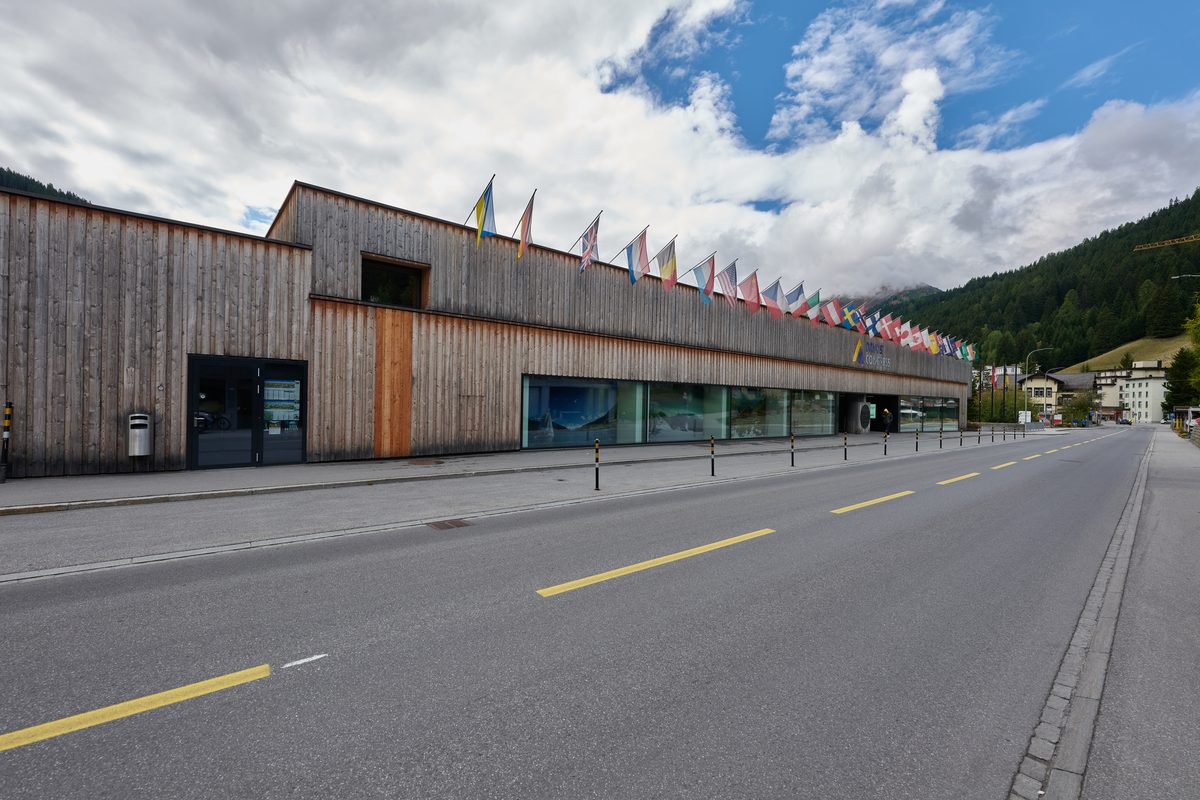
Photographs via Wikimedia Commons: Congress Centre Davos by Leonhard Lenz, CC0 · Schatzalp above Davos by Lantus, CC BY-SA 3.0. Unchanged apart from size.