Why the Nordics: the case for careful capital
The investment case for the Nordics is not a story about growth. It is a story about what does not go wrong: contracts that hold, registers you can read, governments that can pay, banks with capital, and power that is cheap and clean. Add a property market that has repriced to today's cost of capital, and you have a place where careful money compounds.
1. Things that do not go wrong
Start with the institutions, because that is what an investor from outside actually buys. In the World Justice Project's Rule of Law Index for 2025, covering 143 jurisdictions, Denmark ranks first, Norway second, Finland third and Sweden fourth, in a year when rule of law declined in 68 per cent of countries. Transparency International's 2025 index puts Denmark and Finland at the top of the world with 89 and 88 points, Norway at 81 and Sweden at 80, against a global average of 42. The Heritage Foundation's 2026 index of economic freedom ranks all four between seventh and thirteenth of 176.
The practical consequences are what matter to a deal. Property, company and beneficial-ownership registers are public and digital. Court decisions are predictable. English is a working language: Norway, Denmark and Sweden rank fifth, seventh and eighth of 123 countries in the EF proficiency index. A due-diligence process that takes three months in southern Europe takes three weeks here, and the result can be trusted.
2. Governments and banks that can pay
The International Monetary Fund's October 2026 outlook puts general government debt at 26 per cent of GDP in Denmark, 35 in Sweden and 40 in Norway, against 88 per cent in the euro area and 118 in France. Finland is the exception at 91 per cent, which is why Finnish assets carry a small premium. Norway's sovereign fund held 22,014 billion kroner at the end of September 2026, more than four times the country's GDP, and by law invests none of it at home, which means Norwegian assets are priced by private capital, not by the state.
Growth is moderate and that is fine. The IMF expects 2.5 per cent in Sweden, 3.7 in Denmark, 1.7 in Finland and 1.5 in Norway for 2026, against 1.1 for the euro area. GDP per person in current dollars runs from 60,000 in Finland to 115,000 in Norway, with Sweden at 69,000 and Denmark at 83,000. The banks that finance the region report core capital ratios of 15.8 to 17.3 per cent in the third quarter of 2026, well above requirements, and Norges Bank's lending survey reports unchanged credit standards and falling margins. The system is not the constraint. Equity is.
3. A property market that has repriced
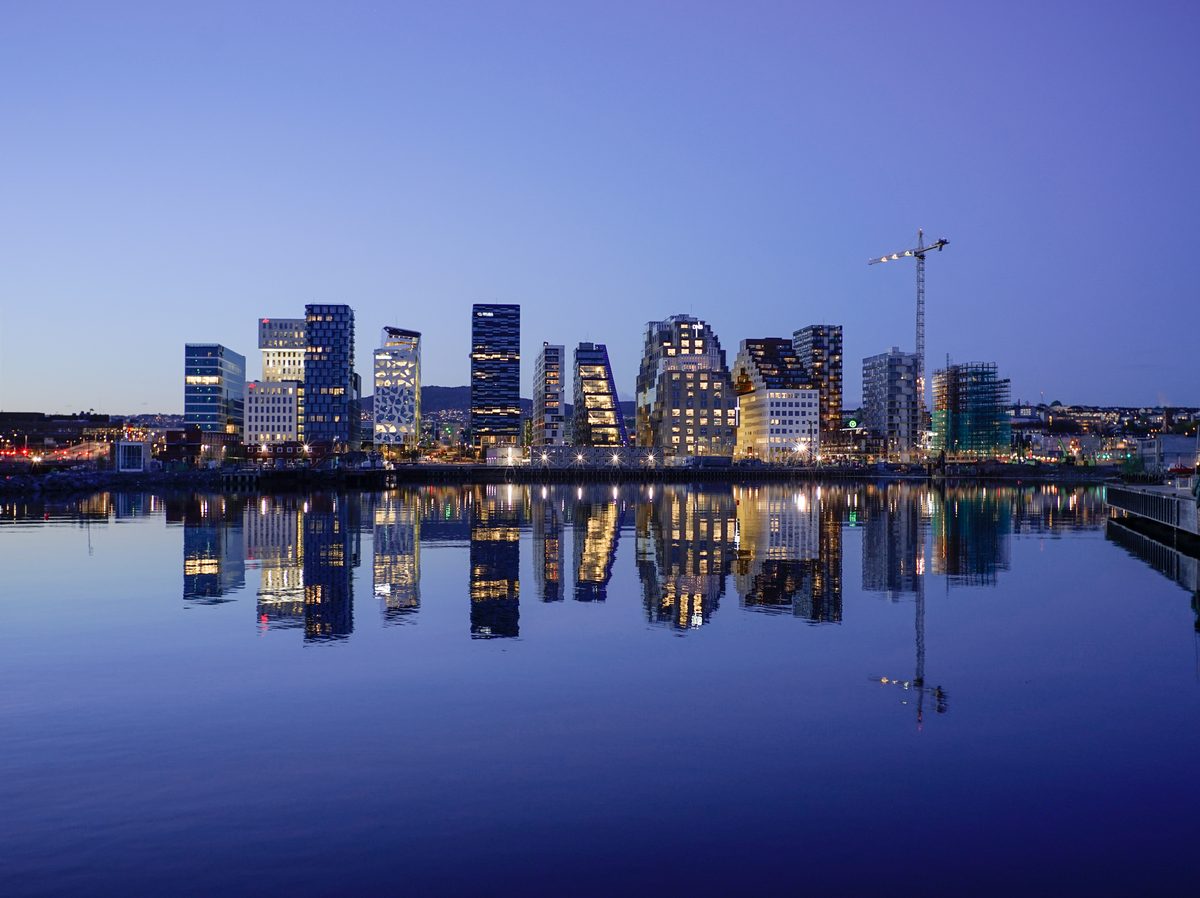
Nordic commercial property transactions reached about 33 billion euros across 910 deals in 2025, up 28 per cent on the year before, and the first half of 2026 added 18.2 billion, up 24 per cent, led by Sweden. Prices have adjusted to the new rates: Stockholm prime office trades at 3.75 per cent against a Riksbank rate of 1.75, Oslo prime office at 4.75 against a Norges Bank rate of 4.50. The gap between the two capitals is the gap between the two central banks, and it is why Norwegian yields of 6.5 to 7.5 per cent on regional retail parks are available to equity buyers while Stockholm is a market for the cheapest money.
Sweden has already been through its correction. The 2023 recapitalisations, Castellum's ten-billion-kronor rights issue among them, cleared the balance sheets, and domestic capital is back: Savills recorded Stockholm office yields moving in by 15 basis points in the third quarter of 2026 while the European average moved out. Norway is where Sweden was two years ago, with property-company failures up 29 per cent in the first nine months of 2026 and syndicates buying what the leveraged cannot hold. That sequence is the opportunity: the market that repriced last is the market where the equity gap is widest.
The investment case for the Nordics is not a story about growth. It is a story about what does not go wrong.
4. Power the rest of Europe is short of
Norway produced a record 161.8 terawatt-hours of electricity in 2025, 89.9 per cent of it hydro, and exported 22.8 net. Sweden generated 99 per cent of its power from low-carbon sources, the highest share in the European Union, with power-sector emissions of 0.6 tonnes per person against an EU average of 1.3. Denmark took about 60 per cent of its production from wind and Finland 37 per cent from nuclear. Household prices in southern Norway sat around 142 øre per kilowatt-hour before support in 2025, and northern Norway at a fraction of that.
That is why the data-centre pipeline has moved north: 3.5 gigawatts reserved in Norway's grid with a further 5.4 in the queue, nearly 5 gigawatts with signed grid agreements in Finland including Google's 13-billion-euro investment, and a Nordic data-centre load that Statnett expects to reach 28 terawatt-hours by 2030. Svenska kraftnät plans 225 billion kronor of grid investment to 2035 and Statnett 150 to 200 billion over ten years. For real assets that is demand for land, logistics and housing in places that had none.
5. The risks, named
- Currency. The krone strengthened 11.5 per cent against the euro in the twelve months to October 2026; the krona was flat. A Swedish investor hedging krone exposure pays roughly the rate differential, 2.75 percentage points.
- Household debt. Swedish households owe 180 per cent of disposable income, the highest ever, and Norwegian households 208 per cent, which is why both central banks move carefully.
- Geopolitics. Finland's border with Russia remains closed, extended again in October 2026, and the US applies a 15 per cent tariff to most EU and Norwegian goods, 50 per cent on steel and aluminium.
- Pricing. Stockholm prime at 3.75 per cent leaves no room for error; the value is in the regions and in Norway, not in the trophies.
6. Why now
The Nordic case is permanent; the entry point is not. Norway's rate stays near 4.5 per cent through 2027 and the research houses expect office yields to peak in 2027, so the next twelve months are the window in which equity buys at today's prices before the rate turns. Sweden has repriced and is recovering, which makes it the market for income and Norway the market for entry. Capital that is careful, patient and prepared can have both, in a place where the downside is governed by law rather than by luck.
About this note. Written by AIGAS with AI support and checked against the sources below, as of 1 November 2026. Official sources (central banks, statistics offices, supervisors) are separated from market research and press. Nothing here is investment advice, an offer or a solicitation. Investment decisions are made by investors with their own advisers, and regulated services are provided by licensed firms.
Sources
- World Justice Project, Rule of Law Index 2025 (professional)
- Transparency International, Corruption Perceptions Index 2025 (professional)
- Heritage Foundation, Index of Economic Freedom 2026 (professional)
- EF English Proficiency Index 2025 (professional)
- IMF, World Economic Outlook October 2026, GDP growth (official)
- IMF, World Economic Outlook October 2026, general government gross debt (official)
- Norges Bank Investment Management, key figures Q3 2026 (official)
- Nordea, investor presentation Q3 2026 (professional)
- Colliers via Realtid, Nordic transaction volume 2025 and H1 2026 (professional)
- Cushman & Wakefield, Sweden MarketBeat, 20 October 2026 (professional)
- Savills, European office yields Q3 2026 (professional)
- Castellum, final outcome of the rights issue, 2023 (professional)
- Statistics Norway, electricity production 2025, 8 May 2026 (official)
- Ember, Sweden electricity profile 2025 (professional)
- Svenska kraftnät, Network Development Plan 2026–2035 (official)
- Statnett, annual report 2025 (official)
- Argus Media, Nordic data-centre demand, 26 March 2026 (media)
- ECB, euro reference exchange rates, daily series (official)
- Riksbank, Monetary Policy Report September 2026 (official)
- Norges Bank, Monetary Policy Report 3/26 (official)
Talk to us
Sponsors: send a short description of the project. Investors and partners: request access to the partner area.
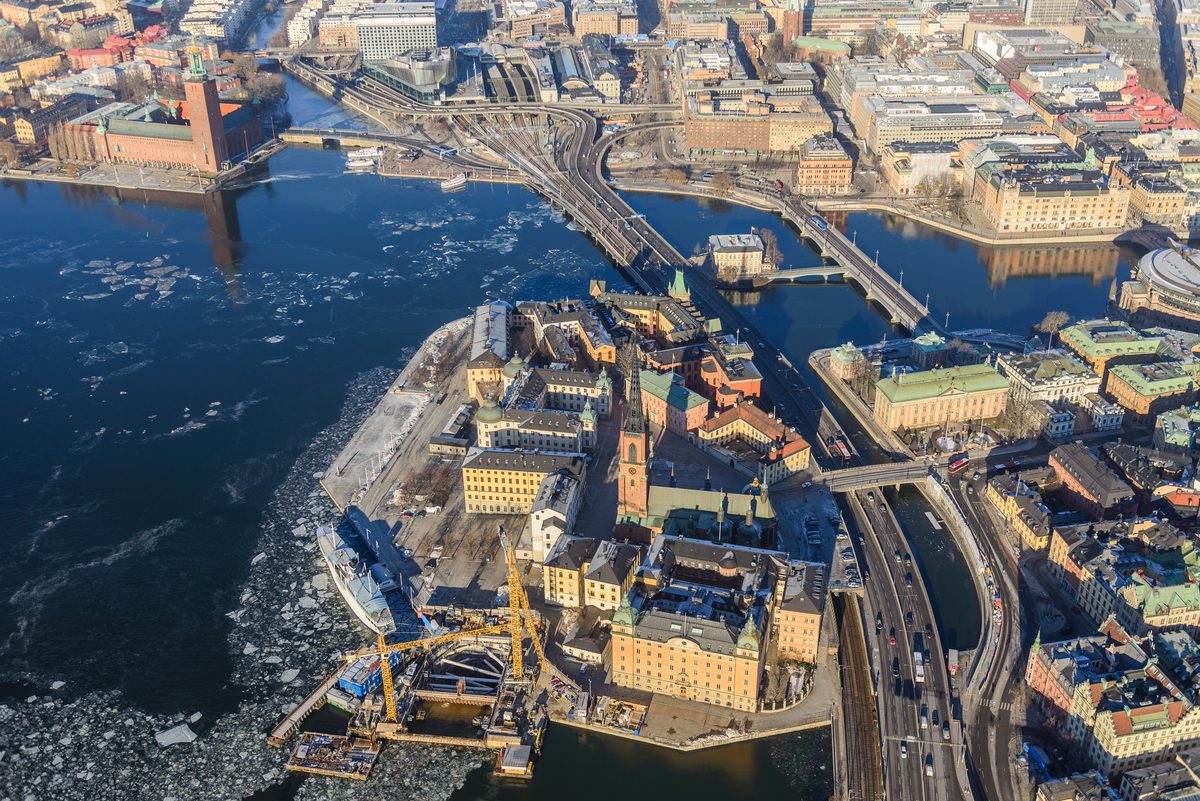
Photographs via Wikimedia Commons: Riddarholmen, Stockholm by Arild Vågen, CC BY-SA 3.0 · Barcode, Oslo by Christoffer Engström, CC0. Unchanged apart from size.